



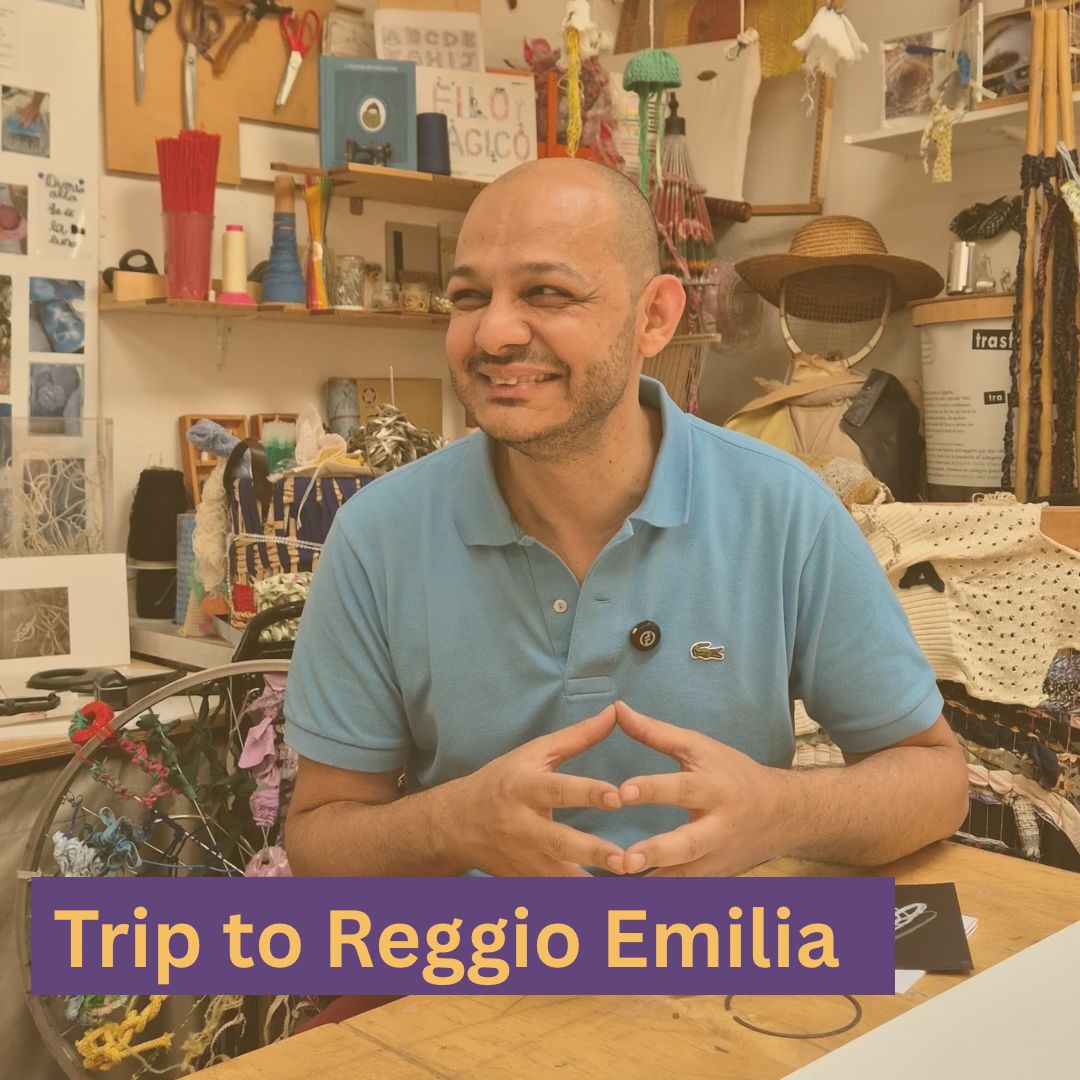
Last week, I had the opportunity to travel to Italy to learn more about the Reggio Emilia Approach. This learning experience was organised by Ambra Lanzi, and it offered a powerful opportunity to step into a context where education is deeply rooted in respect for children, relationships, and the learning process.
During the visit, we explored the Loris Malaguzzi International Center, Remida Bologna, and two early years schools. Each space reflected a deep intentionality in how learning is designed, experienced, and documented. One of the most memorable informal moments was making fresh pasta together and sharing it for dinner, a simple experience that reflected the value of connection and shared learning.
Key Takeaways from Reggio Emilia
The idea I carried back is the image of the child. In Reggio Emilia, children are seen as capable, curious, and full of potential. They are active participants in their learning, not passive receivers of information.
Closely connected to this is the role of the teacher. The teacher is not positioned as the source of knowledge, but as an observer and listener. The teacher prepares provocations and document the learning. This role requires deep attention and a commitment to understanding how ideas emerge and evolve over time.
Another key element is the environment, often described as the third teacher. Learning spaces are carefully designed to provoke thinking, collaboration, and exploration. Materials are open-ended, accessible, and intentionally selected. They are not expensive or overly structured, but instead invite multiple possibilities. Reuse, reduce, and recycle are not just environmental choices, but part of a mindset that values creativity, sustainability, and imagination.
In these spaces, I did not see worksheets or repetitive written tasks displayed on walls. Instead, I saw traces of thinking, documentation of processes, and evidence of learning journeys. The environment itself reflected the learning rather than external products.
What also stood out was how student agency was visible in every detail. Children prepared tables for lunch, organized materials, and moved through spaces with confidence and ownership. Books and resources were everywhere, not as decoration, but as living tools for inquiry and exploration. The outdoor environment was equally important, extending learning beyond the classroom walls and offering rich opportunities for discovery.
Perhaps the most important insight is that none of this can exist without strong collaboration. Parents, educators, leaders, and the wider community all play an active role in shaping the learning experience. Education here is not an individual responsibility, but a shared commitment.
This experience reminded me that Reggio Emilia is not a model to replicate, but an invitation to rethink how we see children, learning, space, and community.
Ali, what you describe here deeply resonates with me given my interest in Reggio. In fact life presented me with a golden opportunity to meet up with Sumire Iikawa (@projectshiro99) she is an atelierista and Reggio consultant based in London whom I had the privilege to meet during July 2025. Her work with children blew my mind and I decided to hire her. For the next two months we worked in my Nursery EYFS-based classroom (children ages 3-4) in London to implement the studio, as a place for the atelier using loose parts, lights and shadows, clay and mark-making.
Beyond the physical creation of the studio, she modelled interactions with children. Here I saw the biggest contrast with what I was trained to do. Arranging small groups of three children, she listened to them, never imposed an agenda. She allowed children to listen to each other while sustaining their interests in loose parts, while verbalising their use of materials and making their actions explicit. At the same time she documented the session with photographs and a document that beyond description, it reflected in the meaning behind their actions.
In the end, she kickstarted a research attitude in my Nursery that eventually led to identifying a project, which in my children’s case was rooted in their interests rather than a fixed curriculum. Today, one year after, we’ve extended this same approach to other interests such as the Birdhouse, Composting and Family/Home projects.
Now I’m gravitating out of the EYFS orbit and into IB. My goal is to cement my skills in developing inquiry and critical thinking skills in preschool children. Similarly I aim to start and sustain conversation with my own community of like-minded educators to take progressive pedagogies such as Reggio Emilia and inquiry-based learning into the wider world.